Friday, October 14, 2022

One Pill Can Kill - Halloween Safety Tips

This Halloween, the Texas Department of Transportation (TxDOT) and the Drug Enforcement Agency (DEA) are teaming up with Texas A&M AgriLife Extension Service’s Watch UR BAC program to spread awareness on the fentanyl epidemic spreading across our state. Fentanyl is a synthetic opioid originally developed as a pain management tool for cancer patients; it is 100x stronger than morphine and 50x stronger than heroin.

The Drug Enforcement Administration warns the public of the alarming increase in the lethality and availability of fake prescription pills containing fentanyl and methamphetamine. International and domestic criminal drug networks are mass-producing fake pills, falsely marketing them as legitimate prescription pills, and killing unsuspecting Texans. These counterfeit pills are easy to purchase, widely available, and often contain deadly doses of fentanyl. Pills purchased outside of a licensed pharmacy are illegal, dangerous, and potentially lethal. These risks include overdose, forming new addictions, and traffic related crashes due to impairment.

Over the Halloween holiday, it is especially important that parents stay informed on this epidemic. One of these most prevalent trends currently involves rainbow-colored pills that have been laced with fentanyl and designed to attract younger kids. “Everyone loves Halloween… it is hard to beat, fall air, costumes, and candy!” said Texas A&M AgriLife Extension FCH Agent Sarah Latham, Rains County. “Unfortunately, we as a community must be aware of the ever-present dangers related to illicit substances. This is a growing threat to our children, and it is our responsibility to protect them”. It is important for parents to understand, one pill containing fentanyl can be lethal.

The U.S. Drug Enforcement Association (DEA) is urging parents to be aware of rainbow fentanyl, a deathly opioid drug traffickers are using to “drive addiction amongst kids and young adults,” DEA administrator, Anne Milgram, said in a statement. Rainbow fentanyl is a drug in the form of a pill or powder that is brightly colored to look like candy and appeal to children and young people. Rainbow fentanyl is also being produced in blocks that resemble sidewalk chalk. As a parent, make sure you prepare and are always aware. 

Ahead of Halloween, local authorities are warning parents to keep a close eye on Trick-or-Treat baskets, just two milligrams of fentanyl, equal to 10-15 grains of table salt, is considered a lethal dose, per the DEA. Any candy-looking substance will get a lot of attention as Halloween nears, so parents should be on the lookout and kids should be reminded never to eat unpackaged candy without having parents inspect it first.

Make sure your children know, they should never accept any candy, pills, or other substances that look like they may have been altered.

Safety Tips:

If you plan to Trick-or-Treat this year, here are a few tips to help you and your kids prepare for a safe and happy Halloween.

  • Only accept and eat candy wrapped in an original, sealed, and unbroken package.
  • If you find an unfamiliar substance, do not touch it. Contact your local law enforcement agency. 
  • Watch your surroundings and stay away from anyone acting suspicious.
  • Stay in well-lit neighborhoods and do not talk to strangers.

By working together, we can save lives and help keep each other safe. Please join us in spreading this important message for the Halloween holiday, One Pill Can Kill.

If you have questions or concerns, please contact me, (903) 473-4580 or email Sarah.Latham@ag.tamu.edu. To view upcoming events or additional information please visit https://rains.agrilife.org/ or follow Rains County AgriLife on Facebook.


Thursday, July 7, 2022

July is National Grilling Month

It is a time to celebrate with family, friends, and your favorite food. This month, go outdoors! Breathe in fresh air and enjoy what nature has to offer with flavors from the grill.

Grilling offers the opportunity to eat a varied selection of proteins such as beef, chicken, wild game, seafood, or tofu. Make sure you expand your options by grilling a variety of fruits and vegetables. You can also experiment with rubs, herbs, or marinades. Your options for grilling are endless, smoked or not, direct or indirect heat, or try a grilled salad. One tool all grillers should have in their toolbox is a thermometer. Food should reach a temperature hot enough to kill harmful bacteria and should be kept at 140°F until grilled food is served.

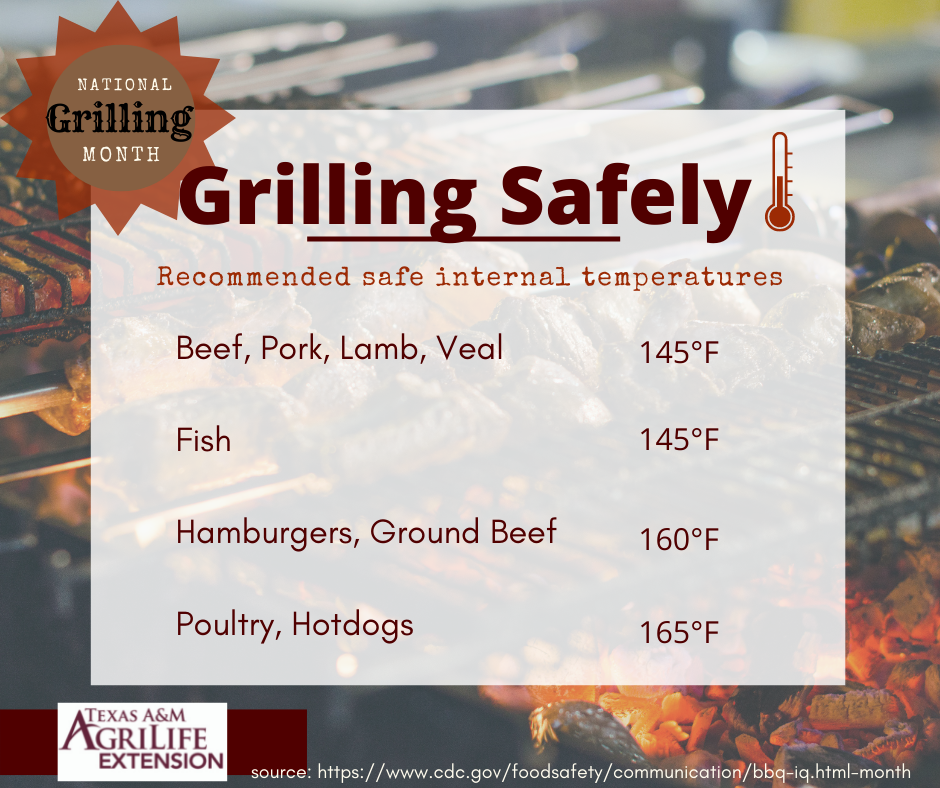
Recommended internal temperatures are:

  • Beef, Pork, Lamb, Veal - 145°F    
  • Hamburgers, Ground Beef - 160°F
  • Fish - 145°F
  • Poultry, Hot Dogs - 165°F

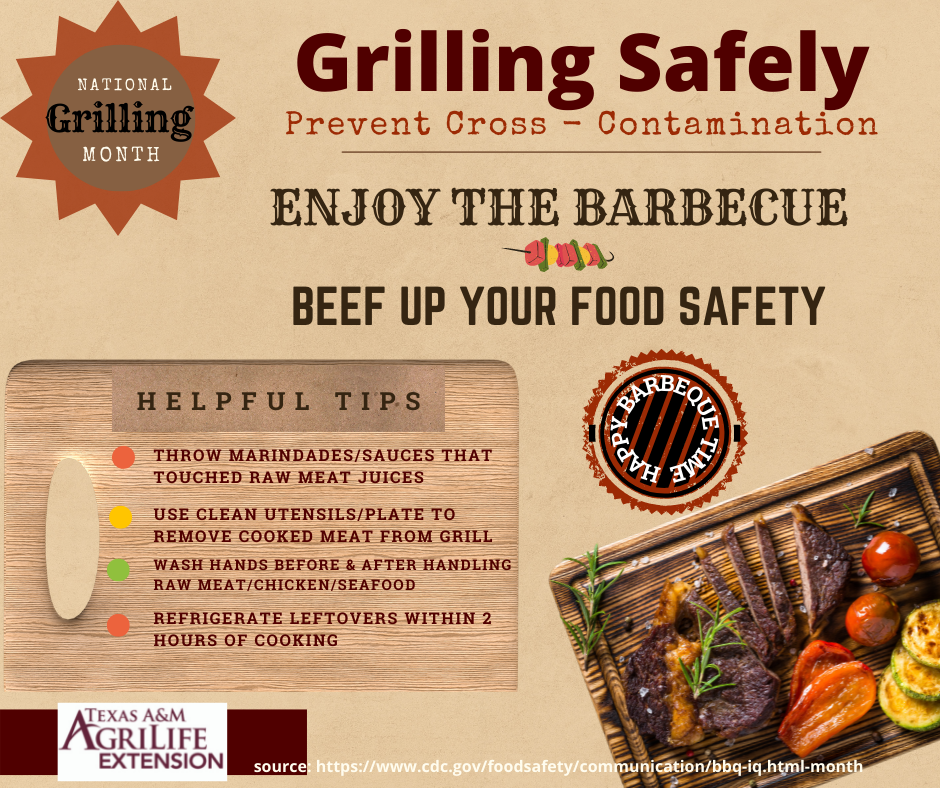
Keep in mind, food borne illnesses increase during summer months because bacteria multiply faster in warm temperatures. Grilling safely follows the same food safety measures used in the kitchen. Make sure you wash your hands before and after handling raw meat, keep raw meats, poultry, and seafood separate from ready-to-eat foods, refrigerate leftovers within 2 hours, and discard leftovers after 4 days.  Grilling is a healthier option than frying because much of the fat contained in or on the food drips out during the grilling process (lowering calories), while preserving vitamins and minerals. In addition to a healthy meal, outdoor grilling also provides an opportunity to spend time in fresh air with family and friends.

This July, take advantage of all the benefits that grilling has to offer.

  • Grilling brings family and friends together.
  • Grilling brings out smiles, cheerfulness, stress-relief, and uplifted moods.
  • Grilling provides entertainment, time to visit with loved ones, and time to make memories.
  • Grilling provides fresh air and Vitamin D (sunshine).
  • Grilling provides an opportunity for children and teens to learn about cooking.

Texas A&M AgriLife Extension has a variety of helpful grilling resources and recipes, visit https://dinnertonight.tamu.edu/?s=grilling  and  https://bbq.tamu.edu/ to learn more.

If you have questions or concerns, please contact me, (903) 473-4580 or email Sarah.Latham@ag.tamu.edu. To view upcoming events or additional information please visit https://rains.agrilife.org/ or follow Rains County AgriLife on Facebook.


Thursday, June 16, 2022

National Safety Month - Work Refrigerator Food Safety

Texas A&M AgriLife Extension observes June as National Safety Month. The month is dedicated to preventing causes of workplace injury. Spending so much time in our workplace lends itself to eating, cooking, and storing food in that workplace. Making sure you follow proper food safety measures can help keep you safe from foodborne illnesses.

Improperly stored food is one of the causes of 48 million cases of food borne illness in the US each year. 128,000 of those cases lead to hospitalizations and 3,000 result in death.

Fridge Basics. For workplace refrigerators and those at home, a refrigerator thermometer is recommended to assure that the internal temperature stays at 40 degrees Fahrenheit (F) or lower. Food kept in between 40 degrees F and 140 degrees F for longer than two hours is no longer safe to eat. This rule is good to remember after parties and celebrations when large amounts are served.

Proper Placement. Raw meat, poultry, and fish should be kept on the bottom of the fridge to prevent any liquids from leaking and contaminating any food, but especially food that will be consumed without cooking. 

Cool Down Quick. Large quantities of hot food, like a pot of soup or a large cut of meat should be divided into smaller portions to cool down more efficiently, thus spending less time in the “temperature danger zone”, between 40 degrees F and 140 degrees F. Small portions of hot food can be put into the fridge and should be covered to prevent drying out and picking up odors from other foods.

Wipe Weekly. Finally, leftovers are only good for 3-4 days. Shared workplace refrigerators should be emptied of leftovers at least once a week. Shelves can be wiped down with a bleach solution (2 teaspoons of bleach and 16 ounces of water) or cleaning product containing bleach. If using a homemade bleach solution, let the product sit on the surface for two minutes, then wipe dry.

The office refrigerator is a great convenience that can help add healthy options to our workday meals, but it often goes overlooked as a place that can harm your health. If you need a refrigerator thermometer, contact the Rains AgriLife Extension office. Taking these steps can help make your lunchtime food safe and flavorful.

If you have questions or concerns, please contact me, (903) 473-4580 or email Sarah.Latham@ag.tamu.edu. To view upcoming events or additional information please visit https://rains.agrilife.org/ or follow Rains County AgriLife on Facebook.